Your expertise deserves the next level of care

Discover how you can elevate post-kidney transplant care
Maribavir is indicated for the treatment of adults and pediatric patients (12 years of age and older and weighing at least 35 kg) with post-transplant cytomegalovirus (CMV) infection/disease that is refractory to treatment (with or without genotypic resistance) with ganciclovir, valganciclovir, cidofovir or foscarnet.1
Choose maribavir (LIVTENCITY) for your post-transplant CMV patients
after 2 weeks of inadequate therapy with other common antivirals.1,2
Explore maribavir’s

SAFETY AND TOLERABILITY1,3
PROVEN EFFICACY1,3
CLEAR STEPS TO GETTING STARTED4
In an open-label clinical trial, maribavir demonstrated the ability to help treat post-transplant CMV infection/disease in adult solid organ transplant or hematopoietic cell transplant recipients with refractory or resistant CMV when compared to monotherapy or dual therapy with other common antivirals (ganciclovir, valganciclovir, foscarnet, or cidofovir) as assigned and dosed by the investigator. The most common adverse events (>10%) in patients treated with maribavir were taste disturbance, nausea, diarrhea, vomiting, and fatigue.1
Demonstrated
safety and
tolerability,
with convenient, twice-daily oral dosing1,3
SOLSTICE, a Phase 3, multicenter, randomized, open-label, active-controlled trial, compared maribavir to investigator-assigned treatment (IAT) with ganciclovir, valganciclovir, foscarnet, or cidofovir, as assigned and dosed by the investigator.1,3
OVERALL,
257 patients (73.0%) completed the study
(maribavir, 199 [84.7%]; other common antivirals, 58 [49.6%]).3
Adverse events (all grades) reported in >10% of patients in the maribavir group (n=234) vs other common antivirals (n=116) included taste disturbance (46% vs 4%), nausea (21% vs 22%), diarrhea (19% vs 21%), vomiting (14% vs 16%), and fatigue (12% vs 9%).1 The mean treatment durations (SD) for LIVTENCITY and IAT were 48.6 (± 13.82) and 31.2 (± 16.91) days, respectively.1
Fewer trial discontinuations due to adverse events occurred in the maribavir group vs other common antivirals (13% vs 32%).1,3
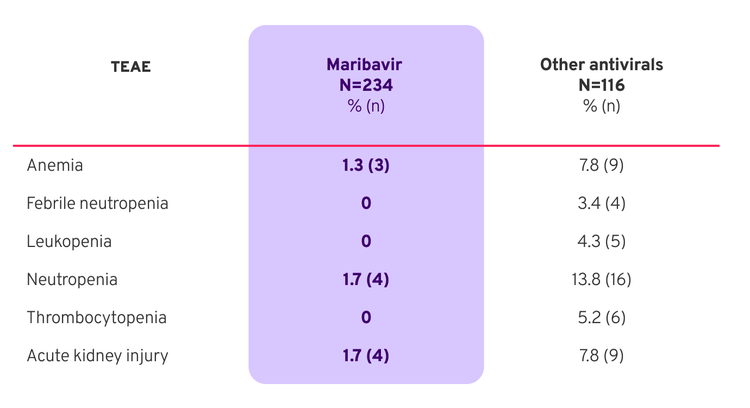
LOWER RATES OF
cytopenias and acute kidney injury were observed with maribavir vs IAT5
When compared to other antivirals.
For treatment-emergent adverse events (TEAEs) that were considered related to study-assigned treatment by the investigator.5
Safety data were analyzed descriptively in all patients who received a dose of study drug (Safety Population).3
LOWER RATES OF
cytopenias and acute kidney injury were observed with maribavir vs IAT5
When compared to other antivirals.
For treatment-emergent adverse events (TEAEs) that were considered related to study-assigned treatment by the investigator.5
Safety data were analyzed descriptively in all patients who received a dose of study drug (Safety Population).3
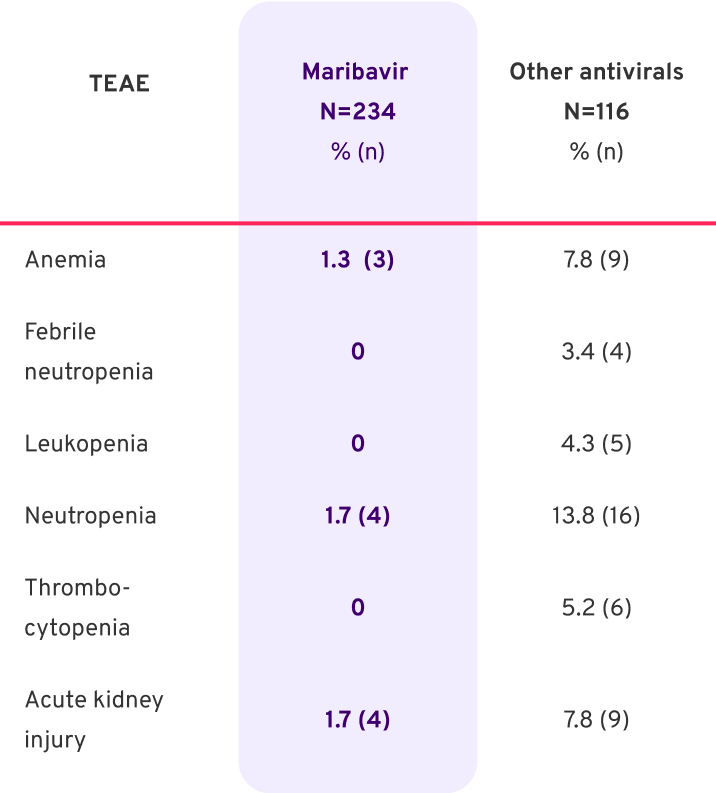
Additional safety results for maribavir vs other antivirals, respectively, for treatment-related TEAEs occurring in ≥5% of patients in either group included: diarrhea: 3.8 (9) vs 5.2 (6); nausea: 8.5 (20) vs 9.5 (11); vomiting: 7.7 (18) vs 4.3 (5); edema peripheral: 0 vs 3.4 (4); investigations: 8.5 (20) vs 7.8 (9); immunosuppressant drug level increased: 6.0 (14) vs 0; hypocalcemia: 0 vs 4.3 (5); hypokalemia: 0.4 (1) vs 4.3 (5); hypomagnesemia: 0 vs 4.3 (5); dysgeusia: 35.9 (84) vs 0.9 (1); headache: 0.9 (2) vs 3.4 (4); taste disorder: 8.5 (20) vs 0.9 (1); renal impairment: 0 vs 2.6 (3); proteinuria: 0.4 (1) vs 1.7 (2); and renal failure: 0 vs 1.7 (2).

Flexibility across care settings:
Maribavir can be prescribed for both inpatient and outpatient use, and is conveniently administered orally with recommended twice-daily dosing1

FEWER TREATMENT DISCONTINUATIONS
with maribavir (13%, n=31/245) vs other common antivirals (32%, n=37/116)1
- Most common reasons for treatment discontinuation were neutropenia (9%) and acute kidney injury (5%) for other common antivirals, and dysgeusia, diarrhea, nausea, and recurrence of underlying disease (each reported at 1%) in the maribavir group

MINIMAL ADJUSTMENTS AND LAB WORK1
- No monitoring or dose adjustments for those with impaired renal function or moderate hepatic function*
- Dose adjustments of maribavir are needed when coadministered with selected anticonvulsants (carbamazepine, phenytoin, and phenobarbital) or rifabutin.
*Impaired hepatic function=mild (Child-Pugh Class A) or moderate (Child-Pugh Class B). Administration in patients with severe hepatic impairment has not been studied. Impaired renal function=mild, moderate, or severe. Administration in patients with end stage renal disease (ESRD), including patients on dialysis, has not been studied.

FEWER RATES OF HOSPITALIZATIONS
and reduced length of stay6
- In an exploratory analysis of the Phase 3 SOLSTICE trial, patients on maribavir had a 34.8% reduction in hospitalization rate and 53.8% reduced length of stay (days/person/year) in hospital vs those treated with other antivirals*
- Foscarnet patients had more hospitalizations for renal disorders than maribavir patients (maribavir 4.7% vs foscarnet 12.8%), likely due to the need for intravenous treatment
*After adjusting for treatment exposure. Results from during the treatment phase.
PRIMARY ENDPOINT
Statistically superior efficacy to common antivirals
(ganciclovir, valganciclovir, foscarnet, or cidofovir)1
More than 2x the proportion of patients achieved CMV DNA level <LLOQ at Week 8 vs other antivirals1
- Primary endpoint: Statistical superiority in achievement of CMV DNA level <LLOQ (<137 IU/mL) (56% [131/235] vs 24% [28/117]; 33% adjusted difference; 95% CI [23, 43]; P<0.001)*†
See key secondary endpoint

PRIMARY ENDPOINT
Statistically superior efficacy to common antivirals
(ganciclovir, valganciclovir, foscarnet, or cidofovir)1
More than 2x the proportion of patients achieved CMV DNA level <LLOQ at Week 8 vs other antivirals1
- Primary endpoint: Statistical superiority in achievement of CMV DNA level <LLOQ (<137 IU/mL) (56% [131/235] vs 24% [28/117]; 33% adjusted difference; 95% CI [23, 43]; P<0.001)*†
See key secondary endpoint
After 2 weeks of inadequate therapy with other common antivirals, consider maribavir1,4:
- Particularly for patients with a low baseline viral load (<9,100 IU/mL)
*Cochran-Mantel-Haenszel weighted average approach was used for the adjusted difference in proportion of responders (MBV-IAT), 95% CI, and p-value, after adjusting for transplant type and baseline plasma CMV DNA level concentration. Computation included only those with both stratification factors.1
†As assessed by COBAS® AmpliPrep/COBAS® TaqMan® CMV test in 2 consecutive samples separated by ≥5 days.1
Timely access with maribavir

PRESCRIBING EXPERIENCE:
- With 3+ years of patient experience, maribavir (LIVTENCITY) has achieved a 94% approval rate for prescriptions*†4
- The Takeda Patient Support Co-Pay Assistance Program for maribavir (LIVTENCITY) can help eligible, commercially insured patients pay as little as $0 per prescription‡

QUICK START PROGRAM:
- Supports eligible patients facing insurance delays in getting immediate access to maribavir (LIVTENCITY)¶§
- Timely transitioning of patient prescriptions from inpatient to outpatient setting: 97% of maribavir patients received their prescription in 3.5 business days on average in the outpatient setting from in-network specialty pharmacies, regardless of whether a Prior Authorization or a Letter of Medical Necessity was required (Dec 2021 to Jan 2025)4
*Including when plan exclusions occurred or when Prior Authorization or a Letter of Medical Necessity were required.
†In the outpatient setting for in-network specialty pharmacies (Dec 2021 to Feb 2025) as reported by Amber, Biologica, and AssistRx.
‡IMPORTANT NOTICE: Takeda’s Co-pay Assistance Program ("the Program") provides financial support for commercially insured patients who qualify for the Program. Participation in the Program and provision of financial support is subject to all Program terms and conditions, including but not limited to eligibility requirements, the Program maximum benefit per claim and the annual calendar year Program maximum (“Annual Program Maximum”). The Annual Program Maximum for your prescribed Takeda product can be found by visiting: https://www.takedapatientsupport.com/hcp/livtencity.
By enrolling in the Program, you agree that the Program is intended solely for the benefit of you—not health plans and/or their partners. Further, you agree to comply with all applicable requirements of your health plan. The Program cannot be used if the patient is a beneficiary of, or any part of the prescription is covered by: 1) any federal, state, or government-funded healthcare program (Medicare, Medicare Advantage, Medicaid, TRICARE, etc.), including a state pharmaceutical assistance program (the Federal Employees Health Benefit (FEHB) Program is not a government-funded healthcare program for the purpose of this offer), 2) the Medicare Prescription Drug Program (Part D), or if the patient is currently in the coverage gap, or 3) insurance that is paying the entire cost of the prescription. No claim for reimbursement of the out-of-pocket expense amount covered by the Program shall be submitted to any third-party payer, whether public or private.
Some health plans have established programs referred to as ‘co-pay maximizer’ programs. A co-pay maximizer program is one in which the amount of a patient’s out-of-pocket costs is adjusted to reflect the availability of support offered by a manufacturer’s co-pay assistance program. If you are enrolled in a co-pay maximizer program, your Annual Program Maximum may vary over time to ensure the program funds are used for your benefit (for the benefit of the patient). Takeda also reserves the right to reduce or eliminate the co-pay assistance available to patients enrolled in an insurance plan that utilizes a co-pay maximizer program.
If you learn your health plan has implemented a co-pay maximizer program, you agree to notify the Program immediately by calling 1-855-268-1825. It may be possible that you are unaware whether you are subject to a co-pay maximizer program when you enroll or re-enroll in the Program. Takeda will monitor program utilization data and reserves the right to discontinue assistance under the Program at any time if Takeda determines that you are subject to a co-pay maximizer, or similar program.
The Program only applies in the United States, including Puerto Rico and other U.S. territories, and does not apply where prohibited by law, taxed, or restricted. This does not constitute health insurance. Void where use is prohibited by your insurance provider. If your insurance situation changes you must notify the Program immediately at 1-855-268-1825. Coverage of certain administration charges will not apply for patients residing in states where it is prohibited by law.
This Program offer is not transferable and is limited to one offer per person and may not be combined with any other coupon, discount, prescription savings card, rebate, free trial, patient assistance, co-pay maximizer, alternative funding program, co-pay accumulator, or other offer, including those from third parties and companies that help insurers or health plan manage costs. Not valid if reproduced.
By utilizing the Program, you hereby accept and agree to abide by these terms and conditions. Any individual or entity who enrolls or assists in the enrollment of a patient in the Program represents that the patient meets the eligibility criteria and other requirements described herein. You must meet the Program eligibility requirements every time you use the Program. Takeda reserves the right to rescind, revoke, or amend the Program at any time without notice, and other terms and conditions may apply.
¶Must meet eligibility requirements.
§Additional terms and conditions may apply.
Have questions or need assistance?
We’re here for you, whenever you need us.
Your regional Transplant Account Manager is ready to help you streamline care for your patients.
Connect with a Takeda Transplant Account Manager in your area
Personalized support with patient access to maribavir:
Contact Takeda Patient Support at 1-855-268-1825
(Monday–Friday, 8:30 AM–8:00 PM ET)


ELEVATING
post-kidney transplant care is within reach.
Make maribavir your choice for post-transplant CMV at the first signs of inadequate treatment response after 2 weeks of common antivirals.1,4

LET US HELP YOU FOCUS
on what matters most—caring for your patients.
Your regional Transplant Account Manager is here to provide tools and resources tailored to you, your staff, and your patients—so you can get the right help, right when you need it.
References: 1. Livtencity (maribavir) Prescribing Information. Cambridge, MA: Takeda Pharmaceuticals U.S.A., Inc. 2. Ljungman P, Chemaly RF, Khawaya F, et al. Clin Infect Dis. 2024;79(3):787-794. 3. Avery RK, Alain S, Alexander BD, et al. Clin Infect Dis. 2022;75(4):690-701. 4. Data on file. Takeda Pharmaceuticals U.S.A., Inc. 5. Avery RK, Alain S, Alexander BD, et al. Clin Infect Dis. Supplement. 2022. doi.org/10.1093/cid/ciab988. 6. Hirji I, Cocks K, Moreno-Koehler A, et al. Transpl Infect Dis. 2023. doi.org/10.1111/tid.14064.